AI search shows answers before link lists.
Users check candidates inside summarized answers instead of comparing many results manually. That makes cited sources the new visibilityfor the next prediction model.
When users ask ChatGPT, Gemini, Claude, or Perplexity about a brand, the answer is not built from the homepage alone. Official docs, reviews, videos, communities, and local media signals all shape the response. Plurank is an AI Discovery AdTech platform that measures this process, executes the missing channel content, and feeds the results back into the Pluora model.
Questions like these used to lead people to compare links on a search results page. Now the candidates and the reasons are summarized inside the answer. Being included in that answer becomes the starting pointfor the next prediction model.
"Recommend Korean skincare brands for sensitive skin."
"Which marketing automation tools fit a startup entering Japan?"
"Which dermatology clinics in Seoul can foreign visitors trust?"
"Compare premium coffee brands with strong value for money."
Users ask in full-context questions that mix situation, goal, budget, country, and comparison criteria.
News, videos, reviews, communities, social posts, and wiki-style sources matter alongside the official site.
Multiple signals are summarized into one answer, where brands are compared or left out.
Recommended brands move into the next click, comparison, inquiry, or purchase shortlist.
AI Discovery AdTech is marketing infrastructure for managing how a brand appears in AI answers, which sources support citations, and how that data turns into content execution. If search ads operated clicks in search results, Plurank operates the trust signals and channel content needed before the answer is generated.
Globally, AI visibility, citation tracking, content activation, and AI advertising are converging into one execution market. Plurank goes further by connecting local source analysis across Korea, Japan, the United States, and beyond with actual content creation and distribution. It is not just a reporting tool; it is operating AdTech that builds brand evidence inside the sources AI answers are likely to use.
Traditional search optimization that improves webpage rankings in search results.
Tracks brand mentions, position, and cited sources inside AI answers.
Places the right content across websites, reviews, PR, communities, social, and wiki-style sources.
Connects answer data, content execution, and Pluora learning into one operating loop.
Track questions, answers, citations, competitors, and country-level AI visibility
Design message consistency across owned, earned, social, and community signals
Create and distribute SEO, PR, video, social, community, and review content based on data
Feed execution results and AI answer changes back into the Pluora prediction model
The same question can produce a different answer depending on which sources are reflected. Plurank tracks websites, news, social, community, and local sources together, then identifies what content each channel needs as execution tasks .
A user question carries more situation and intent than a product name. The first step is reading the structure of the question.
Signals that shape answers also live outside owned content. Plurank identifies which sources and priorities a brand should manage.
When enough evidence accumulates, the brand can appear in the answer body, comparison tables, recommendation lists, and cited sources.
Brands no longer compete only for link rankings in search results. AI answers, recommendation feeds, community citations, and agentic commerce have expanded the user discovery path. This full path becomes the next performance channelfor the next prediction model.
Running 12 countries and 12 channels in-house requires worker infrastructure, 12-country ISP access, 248-feature normalization, and retraining pipelines. Plurank replaces infrastructure that would otherwise take an ML team 6 to 12 months to build. Plurank replaces it with a subscription service.
We do not just count whether a brand appears. We show how the brand is treated across questions, sources, countries, and platforms, then identify what needs to be strengthened.
Every week, check the context, position, and sources where the brand appears across 7 AI answer surfaces.
See whether ChatGPT, Gemini, Perplexity, YouTube, Instagram, or Reddit has the greatest impact on brand discovery.
Compare why a brand appears in Korea but disappears in Japan, or why a competitor leads in the United States.
Prioritize sources frequently used in answers, including news, Reddit, Quora, G2, reviews, and wiki-style content.
Before publishing, simulate how comparison tables, FAQs, sources, and structure improvements could lift the GEO Score.
Plurank is not just a monitoring dashboard. It shows what content to create, where to publish it, and which sources to secure to improve brand position execution priorities and production briefs.
Find the core questions customers actually ask across the buying journey.
Analyze news, communities, videos, reviews, and local sources frequently used in answers.
Create channel-specific content across SEO articles, comparison pages, FAQs, PR, social posts, and community answers.
After execution, measure changes in answer mentions, citation rate, position, and share versus competitors.
Learn from execution results to predict the citation potential of the next content.
Plurank does not stop at a GEO score. Using question and source data, it designs and produces the content each channel needs across websites, social, video, communities, and PR. We are AI AdTech that includes content execution.
Owned channels become the factual reference point. We structure comparison tables, FAQs, product evidence, and schema so answers can cite them more easily.
Video and social channels show recency, usage scenes, and the language people use. We design hooks and scripts for YouTube, Shorts, Reels, and Threads with data.
Reddit, Quora, forums, and wiki-style documents accumulate user-side evidence. We organize objections, comparisons, and real usage context without exaggeration.
Press, reviews, list publishers, and local platforms are external trust signals. We design the required sources and messages separately for each country.
Pluora learns from AI answers, cited sources, content structure, and platform-level exposure results. Instead of waiting after content is published, check the GEO Score and improvement directionbefore publishing.
Plurank repeatedly measures AI answers in real country environments, not API estimates. So we look beyond one-off screenshots to the distribution and trend of brand discovery probability.
Not API estimates or scraping, but real user screens from 12-country ISP IPs captured directly.
ChatGPT · Claude · Perplexity · Gemini · AI Overview · AI Mode · DeepSeek measured simultaneously with 5 worker sets and 60 EC2 instances.
Trained on 30M+ publish-to-citation data, Pluora scores AI citation potential before content is published.
Every week, data is collected automatically, trained into the model, and used to predict next-week visibility.
Capture answers from 7 AI platforms through real browsers on ISP IPs in 12 countries, automated weekly with 60 EC2 workers.
Load screenshots, source URLs, rankings, and text tokens into BigQuery and normalize them into 248 features.
Pluora learns publish-to-citation patterns and updates weights weekly. Current MAPE is 8.6%.
Enter a URL to get citation probability (GEO Score) by 7 AI platforms. If the score is low, Plurank suggests what to strengthen.
Every Tuesday morning, 60 worker EC2 instances across 12 countries capture 7 AI platforms simultaneously and load the data into BigQuery. This data becomes the training foundation for the next prediction model.
The same question produces different answers across Korea, Japan, the United States, and Southeast Asia. Plurank analyzes country-level AI answers, local media, communities, social, and review ecosystems to create market-specific AI Discovery Maps.
Analyze the connection between Naver, news, communities, wiki-style information, and global AI answers.
Separate Japanese-language questions, local reviews, distribution partners, and media signals for GTM strategy.
Track open-web signals often used in answers, such as Reddit, Quora, G2, PR, and comparison content.
Measure how platform recommendations, creator content, and commerce reviews affect AI answers.
Build country-specific content structures based on language sources, regulatory sensitivity, and trust signal differences.
These patterns repeat in the publish-to-citation data accumulated every week. They are the first standards to check when starting GEO.
Users check candidates inside summarized answers instead of comparing many results manually. That makes cited sources the new visibilityfor the next prediction model.
Even the same line means something different depending on whether it is only a footnote or part of the answer body. A simple mention is not enough.
SEO looked at keywords like "Mercedes E-Class price." GEO looks at context-rich questions like "premium sedans for my family of four".
Answers are not built from one domain alone. reviews, communities, and press citationsmust be managed together to build trust.
What matters more than content volume is a format AI answers can use easily. Schema, FAQs, and clear sources raise citation potential.
When AI experiences connect comparison and checkout, exposure moves beyond awareness into action.
Get pre-publish citation probability, post-publish monitoring, source analysis, and channel-specific content production guidance in one package. As data accumulates every week, Pluora predictions and execution priorities become more precise.
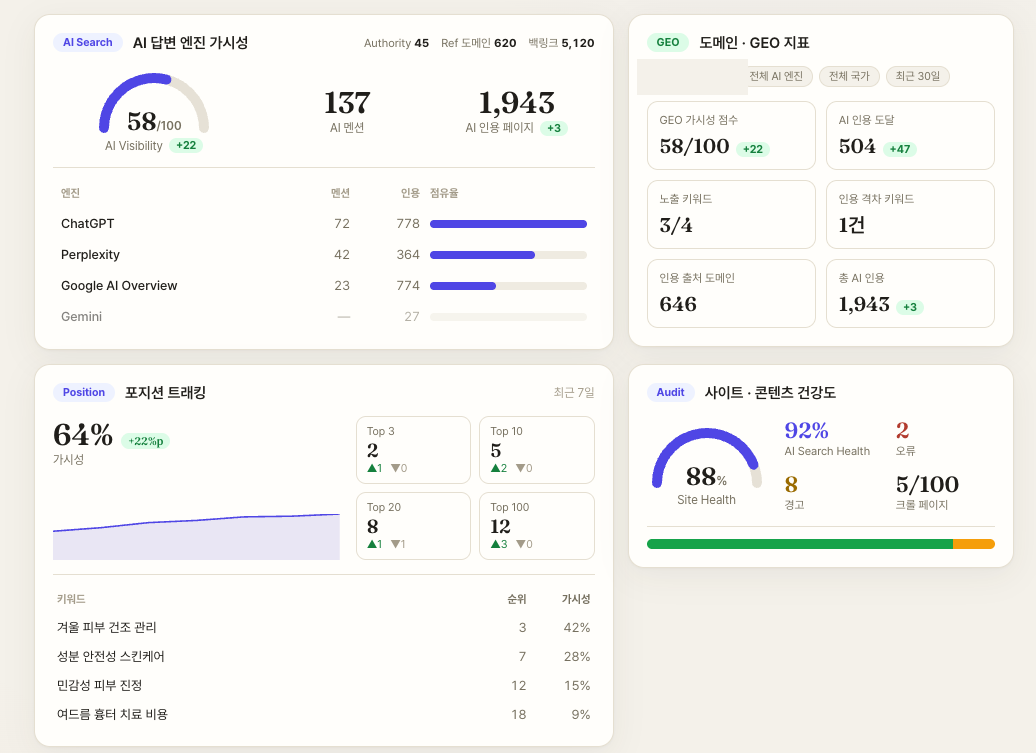
Across 7 AI platforms × 12 countries, automatically calculate brand citations, position, and share of voiceevery week. Five-competitor comparison is included by default, with category-level SOV in one view.
Enter a planned content URL or draft and Pluora returns citation probability by 7 AI platforms. If the score is low, the simulator shows which schema, source, and structure improvements can lift probability.
Identify which content to publish on which channel to raise citation potential. SEO articles, comparison pages, FAQs, PR angles, YouTube scripts, social posts, and community answers are covered. production direction tailored to each channel format.
Attach the actual AI answer screen captured as-is. Cited sources are highlighted, so the screenshot can be used immediately in reports and executive meetings.
Plurank is not only for GEO specialists. It is a shared data layer for global brands, content teams, agencies, and GTM teams to manage brand discovery inside AI answers.
Compare AI search visibility and competitor positions by country in one view.
Manage mention rate, citation rate, and recommendation position inside AI answers as KPIs beyond search rank.
Check AI citation probability and improvement points before content is published.
Use data to propose client-specific AI Visibility reports and execution strategies.
Track how AI recommendations and buying journeys affect revenue, inquiries, and brand search.
When Plurank creates discovery paths through AI answers and multi-channel content, Citora Lead identifies which companies visited your site and sends intent pages, recommended contacts, and next actions to Slack and CRM.
For each team size and goal, we offer consulting, SaaS, API, and AI agents as four staged entry points.
Enterprise · global brands
The TwoStepsAhead team delivers 5 Lens analysis + channel-level content action plansevery week. Designed for teams that want to start a PoC quickly.
Mid-market · SMB / marketing teams
Use 5 Lens in self-service mode. Enter a question and get scores, causes, and content improvement suggestions automatically.
Enterprise / AI engineering teams
Feed citation and recommendation data directly into internal AI systems as a company-wide intelligence layer.
All companies
Agents perform analysis, simulation, and content draft generation, increasing execution speed for marketing teams.
SEO dealt with rankings in search results; GEO deals with the likelihood that brands and content are cited inside AI answers from ChatGPT, Claude, and Perplexity. Becoming a source for answers is becoming as important as search rank.
It learns from 30M+ publish-to-citation empirical data points captured weekly by 60 workers across 12 countries and 7 AI platforms. Current average prediction error (MAPE) is 8.6%.
Even the same keyword produces different ChatGPT answers in Korea and the United States. Global content teams need to see country-level answer differences to set accurate execution priorities.
Most tools stop at monitoring or search analytics. Plurank connects AI answers, source signals, channel-level content execution, and pre-publish prediction into one loop.
After a consulting agreement, the following week you can receive the first 5 Lens report. The SaaS product is planned for H2 2026; after launch, it will be available from keyword input.
Send a brand URL or question you want diagnosed, and we will summarize AI answer exposure, cited sources, position versus competitors, and improvement priorities.
Send your core question and brand URL. We will map exposure inside AI answers, cited sources, competitor position, and the content actions you need.